
Table of Contents
- What Is Rolled Ice Cream? A Clear Definition
- Where Rolled Ice Cream Comes From
- How to Make Rolled Ice Cream: Step-by-Step
- Rolled Ice Cream Ingredients: What Goes Into the Base
- Rolled Ice Cream vs Regular Ice Cream
- Making Rolled Ice Cream at Home: Equipment and Alternatives
- Food Safety and Temperature Guidance
- Common Mistakes and Troubleshooting
- Frequently Asked Questions
Last Updated: October 12, 2026
What Is Rolled Ice Cream? A Clear Definition
Rolled ice cream is a made-to-order frozen dessert created by pouring a liquid ice cream base onto a freezing metal plate, mixing in toppings, and scraping the frozen mixture into thin rolls.
At CreamyFI, we make rolled ice cream fresh daily using organic, pasture-raised milk. The process turns a simple liquid mixture into something memorable.
The dessert goes by several names. You may hear it called Thai rolled ice cream or stir-fried ice cream.
What separates rolled ice cream from a standard scoop? The U.S. Food and Drug Administration food safety guidelines note that frozen desserts must be kept at safe temperatures, and the cold plate method helps here because the dessert stays frozen throughout preparation.
Below, we explain exactly how the process works, what goes into the base, and how you can try it at home.
Where Rolled Ice Cream Comes From
Rolled ice cream is widely described as a Southeast Asian street food, and the most commonly cited origin point is Thailand, where vendors prepared what is often translated as “stir-fried ice cream” on cold metal pans.
That broad outline is well established, but the specific history is harder to pin down than most articles suggest.
What is better documented is the mechanism behind the technique. A freezing metal plate lets a vendor work in front of the customer, which matters for a street stall.
The dessert’s arrival in the United States followed a familiar pattern for visually distinctive foods.
A note on names: “Thai rolled ice cream” and “stir-fried ice cream” are both common, but neither is a formal category.
Rolled ice cream’s origins are best described as Southeast Asian street food, most often linked to Thailand, with the modern U.S. wave arriving in the mid-2010s. The technique spread because a cold plate let vendors make fresh dessert quickly and in front of customers.
How to Make Rolled Ice Cream: Step-by-Step
Making rolled ice cream takes about 5 to 10 minutes once your surface is cold. The basic steps are simple: pour, mix, spread, freeze, and roll.
Here’s the full process:
- Chill your cold plate or frozen pan for at least 24 hours
- Pour about 1/4 cup of liquid base onto the frozen surface
- Add your mix-ins: fruit, cookies, candy, or sauces
- Chop and mix everything together with two scrapers
- Spread the mixture into a thin, even layer
- Wait 1 to 2 minutes for it to freeze completely
- Scrape the frozen layer into rolls from one edge
- Place the rolls in a cup and add toppings
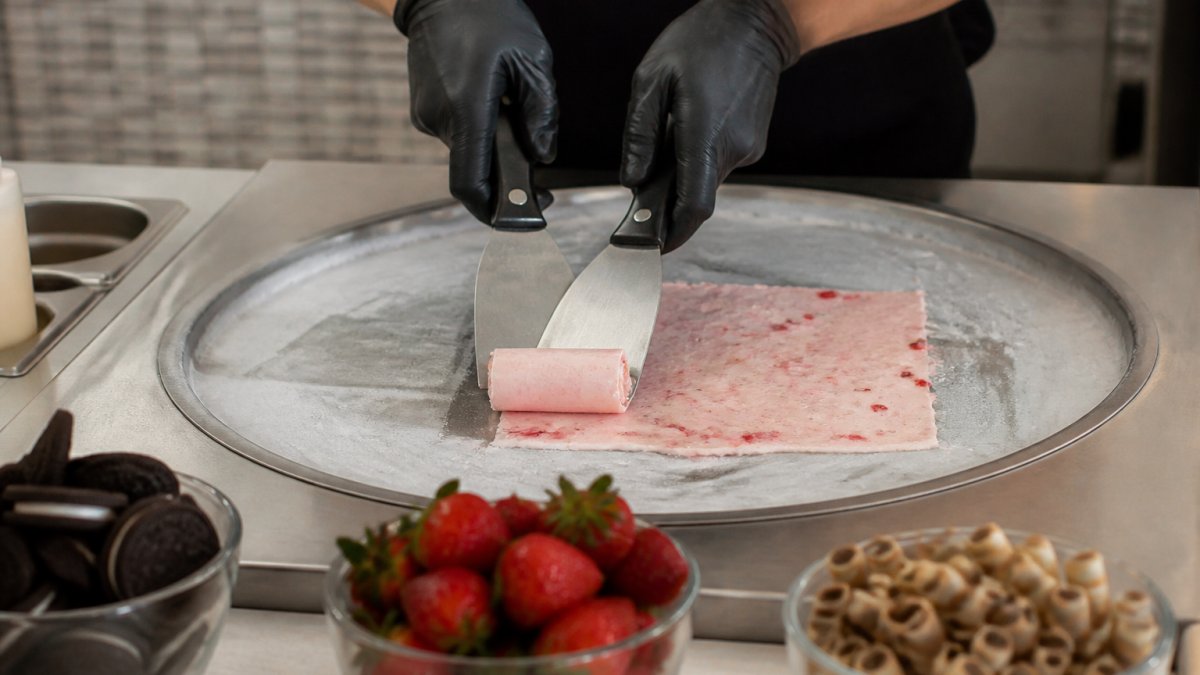
The Cold Plate and Freezing Process
The cold plate is the heart of the process. A freezing metal plate sits at a very low temperature, often well below freezing.
Temperature matters more than anything else. If the plate isn’t cold enough, the base stays slushy and won’t form rolls. If it’s too cold, the mixture freezes before you can spread it.
The thin layer helps too. A spread of about 1/8 inch freezes fast and evenly. That speed is what gives rolled ice cream its smooth texture.
Scraping and Rolling Techniques
Rolling takes practice. You push a metal scraper along the frozen layer at a low angle, and the ice cream curls up into a tight roll.
A few tips from our kitchen:
- Use two scrapers for better control
- Start from the far edge and pull toward you
- Keep the scraper flat against the plate
- Work quickly before the dessert softens
- Make rolls about 1 to 1.5 inches wide
The first few rolls may fall apart. That’s normal. With a little practice, the motion becomes smooth and the rolls hold their shape.
Rolled Ice Cream Ingredients: What Goes Into the Base
The base is what makes or breaks the final texture. A good rolled ice cream base is rich, smooth, and slightly sweet.
Most recipes start with three core ingredients:
- Heavy cream for richness and fat content
- Whole milk for a lighter, scoopable texture
- Sweetened condensed milk for sweetness and creaminess
Some recipes add a little sugar or vanilla for flavor. Others use a custard base with egg yolks, which creates an even creamier result.
At CreamyFI, we build our base with organic milk from pasture-raised cows. We skip artificial hormones, antibiotics, and harmful additives.
The fat content matters. More fat means a creamier dessert and fewer ice crystals.
Mix-Ins and Toppings
Mix-ins are where rolled ice cream gets personal. You can customize each order with almost anything.
Popular mix-ins include:
- Fresh fruit like strawberries, mango, and banana
- Crushed cookies and graham crackers
- Chocolate chips and candy pieces
- Nut butters and chocolate spreads
- Cereal, brownies, and cake bits
Toppings go on top after rolling. Think whipped cream, sauces, fresh fruit, and sprinkles. The mix-ins get chopped into the base on the cold plate. The toppings go on last for texture and color.
Rolled Ice Cream vs Regular Ice Cream
Rolled ice cream and regular ice cream share ingredients but differ in how they’re made and served. The table below breaks down the key differences.
| Feature | Rolled Ice Cream | Regular Ice Cream |
|---|---|---|
| Freezing method | Cold plate, fast freeze | Churned, slow freeze |
| Texture | Dense and creamy | Airy and scoopable |
| Serving | Rolls in a cup | Scoops in a bowl or cone |
| Customization | Mixed in fresh per order | Set flavors |
| Prep time | Made to order | Pre-made |
| Visual appeal | High, photo-friendly | Standard |
The biggest difference is freshness. Rolled ice cream is made in front of you, so the mix-ins are folded in right before you eat it. Regular ice cream is churned in batches and stored.
Texture sets them apart too. The fast freeze on a cold plate creates smaller ice crystals than a home churn. That gives rolled ice cream a denser, smoother bite.
Making Rolled Ice Cream at Home: Equipment and Alternatives
You do not need a commercial cold plate to make rolled ice cream at home, but the method you choose changes the result. The table below compares the realistic options, including what each one actually requires and where it falls short.
| Method | How it works | Target surface temp | Trade-offs |
|---|---|---|---|
| Dedicated countertop rolled ice cream maker | Built-in compressor or pre-frozen plate | Roughly -10°F to -20°F | Easiest and most consistent; highest upfront cost; takes counter space |
| Frozen metal sheet pan | Pan chilled in a freezer overnight | Depends on freezer; typically 0°F or below | Budget-friendly; small batches only; surface warms quickly between pours |
| Ice and rock salt in a tray | Metal tray set over ice and salt | Can reach roughly 0°F to -10°F | No electricity needed; messy; uneven cooling across the surface |
| Frozen pizza stone or baking steel | Stone or steel chilled for 24 hours | Depends on freezer | Heavy and slow to chill; results vary widely; not designed for scraping |
Whichever method you choose, the key is a very cold, flat metal surface. Chill it for at least 24 hours before you start. A cold surface is the one thing you cannot skip.
A few practical notes that most guides leave out:
- Freezer temperature matters more than chill time. A freezer set to 0°F will get a sheet pan colder than one set to 10°F, even after the same 24 hours. Check your freezer setting before you blame your technique.
- Work in small batches. A standard sheet pan holds enough base for one or two servings. Pouring more than about 1/4 cup at a time gives you a layer that is too thick to freeze through and roll cleanly.
- Keep the plate dry. Frost or condensation on the surface will steam when the base hits it and leave you with a slushy layer. Wipe the plate just before pouring.
- Pre-chill your scrapers. Metal scrapers straight from the freezer stay cold longer and are less likely to warm the frozen layer as you work.
- Have everything ready before you pour. The base freezes in one to two minutes. Mix-ins, toppings, and cups should be within arm’s reach.
Freeze your metal pan upside down so the flat bottom gets the coldest. That surface is where you’ll spread the base, and it needs to be as cold as possible before the first pour.
If you are deciding whether to buy a machine, the honest answer is that a dedicated maker is worth it only if you plan to make rolled ice cream often. For occasional use, a frozen sheet pan and two scrapers will get you a recognizable result at a fraction of the cost. The machine buys consistency, not a different dessert.
Do not use a glass or ceramic dish in place of a metal pan. These materials do not conduct cold the way metal does, and they can crack when the frozen base is scraped. Stick to metal.
Food Safety and Temperature Guidance
Frozen desserts need careful handling. The USDA Food Safety and Inspection Service guidance on perishable foods recommends keeping cold foods at 40°F or below to slow bacterial growth.
A few safety habits matter for rolled ice cream:
- Keep your base refrigerated until you’re ready to use it
- Don’t leave the liquid mixture at room temperature for long
- Clean your cold plate and scrapers between batches
- Use pasteurized dairy products
- Serve immediately after rolling
The cold plate itself helps here. Because it freezes the base so fast, the dessert spends very little time in the temperature danger zone. Still, don’t leave finished rolls sitting out. They soften quickly and should be eaten right away.
If you’re serving guests, keep unopened base in the fridge and only pour what you’ll roll next.
Never refreeze base that has been sitting out at room temperature. Once dairy sits above 40°F for more than two hours, bacteria can multiply fast. Toss it and start with a fresh batch.
Common Mistakes and Troubleshooting
Most rolled ice cream problems come down to temperature and technique. Here’s how to fix the most common issues.
| Problem | Likely Cause | Fix |
|---|---|---|
| Base won’t freeze | Plate not cold enough | Chill 24+ hours |
| Rolls fall apart | Layer too thick | Spread thinner |
| Mixture freezes too fast | Plate too cold | Let it warm slightly |
| Rolls taste icy | Too little fat | Add more cream |
| Mix-ins clump | Added too late | Add before spreading |
A common mistake is rushing the chill time.
Another mistake is overfilling the plate. A thin layer freezes evenly.
What most guides miss is the scraper angle. Holding it too upright tears the frozen layer instead of lifting it.
If your rolls still won’t hold, your base may be too thin. Add a little more heavy cream and try again.
Frequently Asked Questions
Where does rolled ice cream come from?
Rolled ice cream originated in Southeast Asia, particularly Thailand, where street vendors developed the technique of pouring a liquid ice cream base onto a frozen metal plate, mixing in fresh ingredients, and scraping the frozen mixture into rolls. It gained popularity in the United States around 2015 and has since become a trendy dessert option in many cities.
What’s the difference between rolled ice cream and regular ice cream?
The main difference is in the preparation and texture. Rolled ice cream is made to order on a frozen plate, creating a denser, creamier texture with visible mix-ins. Regular ice cream is churned and stored frozen, resulting in a lighter, airier consistency.
Can you make rolled ice cream at home without a cold plate?
Yes, you can make rolled ice cream at home without a professional cold plate. Alternatives include using a inverted baking sheet or a large metal pan placed in the freezer until very cold, or using a frozen pizza stone. The key is to have a surface that stays below freezing while you spread and scrape the ice cream base. A home freezer set to 0°F (-18°C) or lower works well.
What toppings go well with rolled ice cream?
Popular toppings for rolled ice cream include fresh fruit like strawberries, mangoes, and bananas; cookies such as Oreos; candy pieces; nuts; chocolate syrup; caramel; and whipped cream. You can customize based on flavor preferences. For a premium experience, consider using organic ingredients and high-quality toppings like ceremonial-grade matcha or fresh berries.
Rolled ice cream is one of those desserts that rewards a little practice. The process is simple once you understand the cold plate, the base, and the roll. If you’d rather skip the setup and enjoy it made fresh, CreamyFI handcrafts every cup daily with organic, pasture-raised milk and no artificial additives. Our menu covers rolled ice creams, authentic bubble teas, and catering for parties and events. Visit CreamyFI to order online and taste the difference fresh ingredients make.